Tick Bites: What Every California Family Should Know
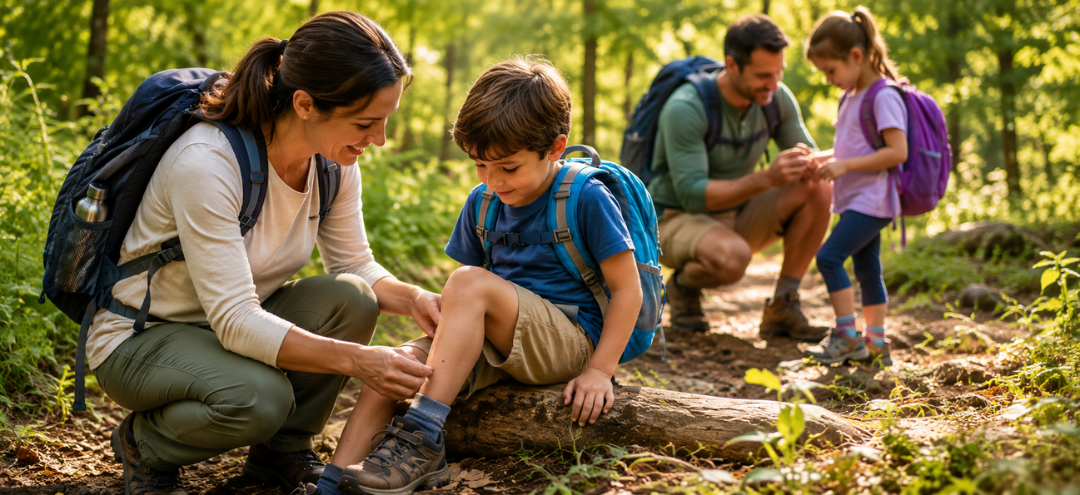
Summer means more time outdoors—hiking, camping, playing in parks, and exploring nature. While enjoying the beautiful California weather, it's helpful to know how to prevent tick bites and what to do if you find one on your child.
The good news? Tick-borne diseases are uncommon in California. While ticks are found throughout the state, only a small percentage carry diseases such as Lyme disease, and transmission typically requires the tick to remain attached for many hours. Most tick bites do not result in illness.
Preventing Tick Bites
Fortunately, a few simple habits can dramatically reduce your family's risk of tick bites.
Before Heading Outdoors
Dress to protect. Wear long sleeves and long pants whenever possible. Tuck your pant legs into your socks and your shirt into your pants to help prevent ticks from crawling underneath your clothing.
Choose light-colored clothing. Ticks are much easier to spot against light-colored fabrics, making it easier to remove them before they attach.
Use an EPA-registered insect repellent. Apply repellents containing DEET, picaridin, IR3535, or oil of lemon eucalyptus (OLE) to exposed skin according to the product label. (Oil of lemon eucalyptus should not be used on children younger than 3 years.)
Treat your gear. Spray boots, clothing, and camping gear with 0.5% permethrin before your outing. Permethrin kills ticks on contact and continues working through multiple washings. Never apply permethrin directly to the skin.
While in Nature
Stay on the path. Walk in the center of trails and avoid tall grass, brush, and leaf litter where ticks are commonly found.
Watch where you sit. Avoid sitting on fallen logs, stone walls, or damp, shady areas at the edges of forests, where ticks often wait for passing hosts.
When You Return Home
Dry your clothes on high heat. Place outdoor clothing in the dryer on high heat for 10–15 minutes as soon as you return home. The dry, intense heat is effective at killing ticks, whereas a standard wash cycle alone may not.
Take a shower. Shower within two hours of coming indoors to wash away any unattached ticks and provide another opportunity to check your skin.
Perform a thorough tick check. Carefully examine yourself, your children, and your pets after spending time outdoors. Pay special attention to hidden areas such as:
- The scalp and hairline
- Behind the ears
- Under the arms
- Around the waist
- Behind the knees
- The groin and between the legs
How to Safely Remove a Tick
If you discover a tick attached to your child's skin:
- Use a pair of fine-tipped tweezers.
- Grasp the tick as close to the skin's surface as possible.
- Pull upward with steady, even pressure. Avoid twisting or jerking the tick.
- After removal, wash the bite area and your hands thoroughly with soap and water.
- Dispose of the tick by placing it in alcohol, sealing it in a bag, or flushing it down the toilet.
Avoid home remedies such as applying petroleum jelly, nail polish, essential oils, or using heat. These methods do not help the tick detach and may actually increase the chance of disease transmission.
When Should You Call Us?
Most tick bites require nothing more than observation. However, please contact us if:
- Tick bite occurred on the East Coast or Sierra Nevada range of Northern California.
- The tick was attached for 36 hours or longer, especially if exposure occurred in an area known for Lyme disease.
- You cannot completely remove the tick.
- The bite becomes increasingly red, swollen, painful, or begins draining pus.
- Your child develops a fever, unusual fatigue, headache, muscle or joint pain, or swollen lymph nodes within several weeks after the bite.
- You notice a spreading rash, particularly one that gradually expands over several days.
- You have any concerns or are unsure whether your child needs to be evaluated.
A Few Reassuring Facts
Finding a tick can be alarming, but remember:
- Tick-borne illnesses are rare in California.
- Prompt removal greatly reduces the risk of disease transmission.
- Most children who are bitten by a tick remain completely healthy.
As always, if you have questions about a tick bite or any other summer health concern, our team at Beverly Hills Pediatrics is here to help. We are happy to guide you on whether your child should be seen or simply monitored at home.
We hope your family enjoys a safe, healthy, and adventure-filled summer!